Showing posts with label pedagogy. Show all posts

Tuesday, July 9, 2013

GEOGstandards revisited


Worth checking out in light of modelling good geography teaching

Although not a new resource, it is opportune to direct attention to the GEOGstandards resource which went live in 2009. With the focus now on the implementation of the new Australian Curriculum: Geography and the desire to promote the teaching of quality geography, this resource provides valuable ideas, exemplars of practice and direction in relation to geography pedagogy. The initiative conducted by Melbourne University on behalf of the Australian Research Council (ARC), with the the support of the Australian Geography Teachers Association (AGTA), the  Geography Teachers Association of Victoria (GTAV) and the Victorian Institute of Teaching came out of a desire to document 'good geography teaching' in a professional and 'user-friendly' way. As well as providing excellent interviews and videos of teachers and students involved in the lessons, the GEOGstandards resource also involved the development of the very useful 'Professional Standards for accomplished teaching of school geography'.  Although the resource does not directly link to the Australian Curriculum: Geography (the project was completed during the early stages of developing the ACARA geography curriculum), it does provide extremely valid guidance on the content pedagogical knowledge at the core of the teaching of quality geography

The research involved the videotaping of accomplished geography teachers at work in government and non-government schools in Victoria, New South Wales and South Australia. Each of the ten geography teachers, with a reputation for accomplished practice, were filmed, across two lessons. Interviews were also conducted with these teachers and their students in an attempt to identify features of accomplished geography teaching. 

To take advantage of all that the site offers it is best to work your way through the samples as listed below. There really is a lot of great material to model good geography teaching on this site. 


Sunday, June 16, 2013

Upskilling geographical knowledge


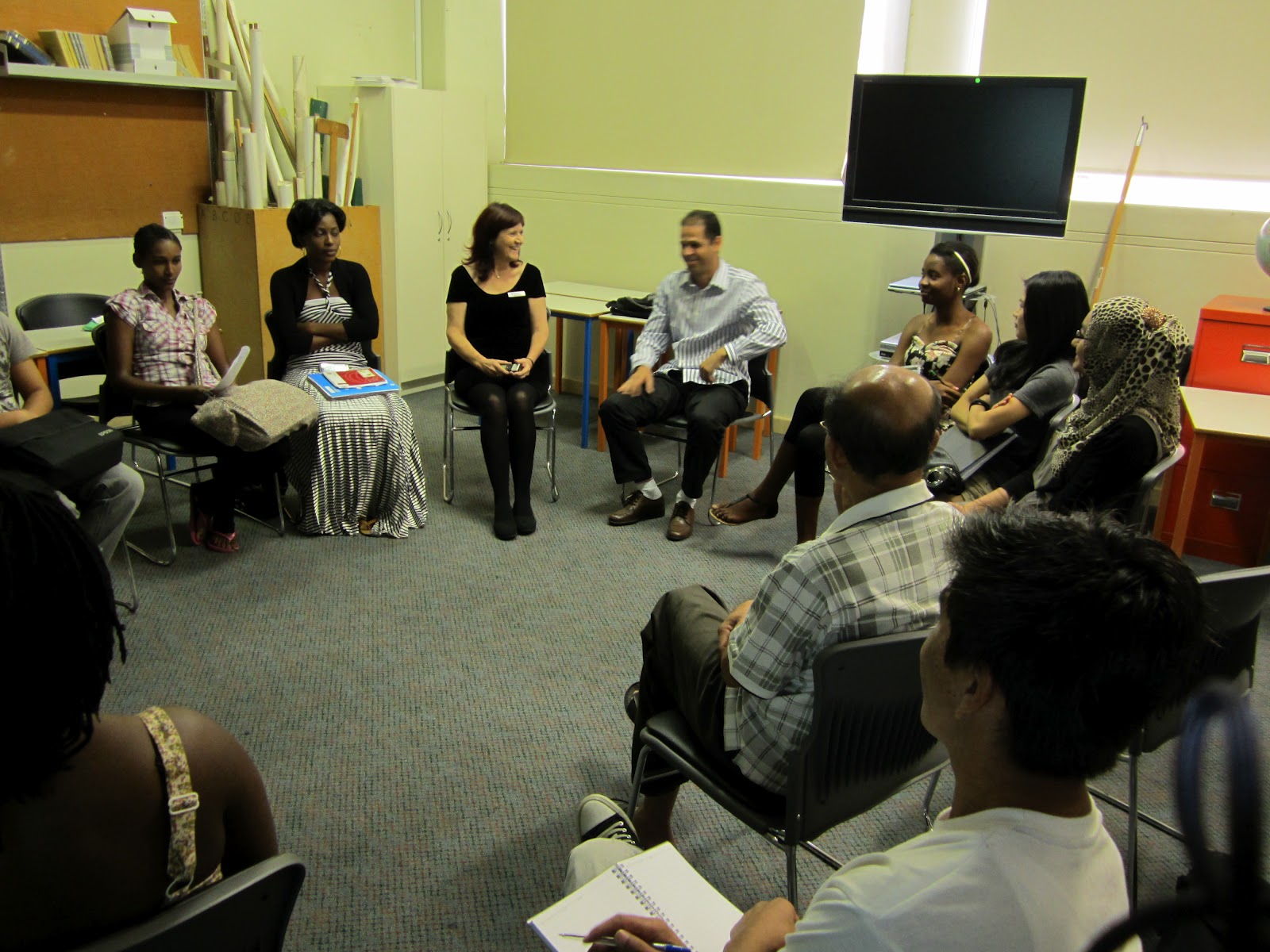
Image above: Professional learning in geography and history being presented at Port Augusta, South Australia.

Related links
Geogaction
Spatialworlds website
Australian Geography Teachers' Association website
'Towards a National Geography Curriculum' project website
Humsteach blog

GeogSplace blog
 

Geographical thinking Scoop.it  
Spatial literacy Scoop.it  
History and geography Scoop.it 
Spatial Education and technology Scoop.it   

Follow Spatialworlds on Twitter

Email contact:

manning@chariot.net.au

Where am I??  

Melbourne, Australia:S: 37º 47' E: 144º 58'


The place of knowledge content
In recent years the need for teachers to have knowledge content in geography has been denigrated by the pedagogical purists. I have frequently heard that, “if you are a good pedagogist you can teach anything!” Such an approach is basically flawed from the point of view that a teacher must feel confident in their knowledge and skill base in a subject before they can really develop rich and challenging (and valid) pedagogy in a discipline. This is particular pertinent to geography in our schools because there is a critical shortage of geography trained teachers available to deliver the curriculum. The question must be asked: “Can we expect the new Australian Curriculum:Geography, a curriculum written with considerable discipline rigour, be taught well by teachers with sparse geography knowledge and skills?” The pedagogical purists would say yes, but increasingly those responsible for the delivery of the curriculum are saying: "... how can we help teachers gain the content knowledge so that they can develop challenging and rigorous pedagogy". The issue is being further accentuated by the fact that the learning area consultant/advisor model which was in place throughout the 1970-1980’s has been dismantled by jurisdictions across Australia. The jurisdictions have gone towards professional learning in areas of general pedagogy, literacy and numeracy rather than providing comprehensive professional learning in the disciplines (science, mathematics and English being the exceptions to some extent). As a result, teaching associations across Australia have picked up the role of professional learning in their subject area but their capacity to deliver is limited by resources and time.  Having thought long and hard on this issue I was interested in the recent post comment and materials from Professor Seth Dixon (Rhode Island College). He also argues that there is an urgent need to help teachers engage with geographical content: knowledge (which includes the concepts), skills and understandings so that they can think like a geographer and work with the geography curriculum successfully.   

“Several schools have noticed that without geography classes, social studies teachers have difficulty becoming certified without some core geographic content. As a part of my job at the Alliance coordinator for the Rhode Island Geography Education Alliance, I'm giving a workshop designed to strengthen teachers geographic content. Most of the images in the presentation are hyperlinked to articles, videos and infographics that I have posted here in the past.”


Whilst there is no quick fix with helping teachers to tackle the content knowledge learning curve, such an attempt is an interesting start. With the recently released GeogSpace project (developed by AGTA and not jurisdictions) we have tried to provide guidance for teachers to develop fundamental geography knowledge, understanding and skills. The supporting units section of the site provide illustrations of practices in the areas of:
  • Geographical thinking
  • Fieldwork
  • ICT in geography
  • Assessment in geography
  • Geographical language
  • Geographical skills
  • Geographical understandings
  • Professional practice
  • Why teach geography
I hope the GeogSpace resource will help teachers to be ‘upskilled’ in geography and engage with rigorous geographical learning in the classroom (beyond colouring in and paper mache models) and learn some geography, so that they can be teachers of geography despite their dearth of geographical background.The GeogSpace website is now live at http://www.geogspace.edu.au 
The challenge for geographers in Australia over coming years is to tackle the need to provide ‘non-geography’ teacher teachers with professional learning to become geographers. Without that knowledge the curriculum will not live up to the expectation to be a vehicle to re-introduce high level geography into Australian schools from Foundation to Year 12. 

Thursday, May 10, 2012

The Now and You: Making Geography real for students

Authentic learning in the classroom with a guest
Authentic learning in the field


Related sites to the Spatialworlds project
Email contact
manning@chariot.net.au
Where am I??
Melbourne, Australia: S: 37º 47' E: 144º 58'


The Now and You

One of the buzz words in pedagogy these days is "Authentic learning".  In the past we called it Experiential  Learning! Either way, it is to make the learning as real as possible for students - for students to see the relevance of what they are doing and their learning as relevant to their life's now and in the future.  Of all the subjects, geography with its feet firmly planted in the living and non-living world within which humans live and its currency (things happening now) is well placed to be seen as a subject well positioned to provide authentic learning opportunities for students. 

Sometimes we relate this topic to the area of careers using geography but we should also be cognisant to the fact that geography is one of the few subjects which use the world within which a student lives now as a laboratory for study. In the Educause paper, Authentic learning is defined as:

"Authentic learning typically focuses on real-world, complex problems and their solutions, using role-playing exercises, problem-based activities, case studies, and participation in virtual communities of practice."

The Educause Learning Initiative cited above goes on to link the potential of technology to enhance Authentic Learning.  The paper, titled "Authentic Learning for the 21st Century" says that:

"Learning-by-doing is generally considered the most effective way to learn. The Internet and a variety of emerging communication, visualization, and simulation technologies now make it possible to offer students authentic learning experiences ranging from experimentation to real-world problem solving. "

This is an excellent paper which affirms much of the discussion on this blog in regards to spatial technology and creative enquiry methods inherent in the use of technologies such as GIS.

The following quote is a geographical adaption to a piece from an Authentic Learning site:

Authentic learning says that...we should learn what happens in the "real world", and become "cognitive apprentices" to the experts. When we learn about geography, we learn to think like geographers. When we learn about the weather, we learn to use tools that a meteorologist would use. 


In regards to pedagogy, it is said that "Authentic learning, is a teaching method that allows students to explore, discuss, and meaningfully connect concepts and relationships that are relevant to the real-world and are meaningful to the students (Donovan, Bransford, &Pellegrino, 1999). Authentic instruction, which differs from traditional teaching methods, use teaching strategies such as: structuring learning around genuine tasks, employing scaffolding, engaging students in inquiry and social discourse, and providing ample resources from the school and community (Donovan et al., 1999; Roth, 1992)."


From the same site I found this list of Authentic Learning characteristics of considerable interest:
  • Learning is real-world oriented and has value beyond the school setting.
  • Learning is often interdisciplinary.
  • Students use higher-order thinking skills and learn concepts as well as basic facts.
  • The classroom is learner centered and allows for a variety of learning styles.
  • Students have ownership of their learning.
  • Instruction uses hand-on approaches and is accessible for all learners.
  • Learning is active and student driven.
  • Teachers act as coaches or learning facilitators. They are one of many resources students may turn to for learning. Parents, outside experts, and community members may all serve as sources for learning.
  • Scaffolding allows students to receive help when they need it and allows them to work freely when they can accomplish tasks on their own.
  • Learning uses real-time data, which students investigate and from which they draw conclusions.
  • Students often work together and have opportunities for discussion as they work to solve the problem.
  • Students produce a product that is directed toward a real audience.
All of these characteristics resonate with the use of spatial technologies in the classroom and with the 21st Century aims of the Australian Curriculum: Geography to make geography real and relevant to students - in the here and now.


Here is a great video on the work of geography and geographers which may be useful for teachers to use to get the message across that geography is about the 'now and you', as a person living in the world. As a way to convince the students that what they do in a geography class or in the field is authentic and real, a little bit of classroom focus on the work of the geographer would not go astray.  Here are some more "the work of the geographer" type of resources.